
Anthropic’s Economist in the Anthropocene
Sometimes Models Collapse

The Anthropic Institute recently hired the Stanford professor Charles I. Jones to help achieve its goal “to confront the most significant challenges that powerful AI will pose to our societies.” As another economics professor put it, this means that Jones will now “be at the center of the world”: he will help to shape the views of our new AI overlords about the future evolution of our societies.
Jones’ view of our past is therefore worth taking seriously. It can be found in a 2001 article called “Was an Industrial Revolution Inevitable? Economic Growth Over the Very Long Run.” He begins with a simple causal chain in which population growth leads to innovation, allowing productivity to increase:
More people (N)
↓
More researchers (LA)
↓
More ideas (A)
↓
Higher output (Y)
↓
Supports more people (N)
Jones then uses this causal chain to build a model that simulates the Industrial Revolution, matching notional estimates for population and consumption since 10,000 BCE from Michael Kremer and Angus Maddison. His initial simulation produces thousands of years of very slow growth followed by a sharp rise around the Industrial Revolution. It tracks Maddison’s per capita consumption closely but systematically overpredicts population, which stabilizes at more than 400 billion by 2200. Jones calls these future predictions “interesting even if they should not be taken seriously.”
What follows is an exercise in curve-fitting. To get a better fit, he then sets the values of two parameters: the share of profits received by innovators from their innovations (π) and “productivity shocks” (ε) due to factors such as the Mongol invasions, Black Death, colonization of the Americas, et cetera. Both the simulated population and consumption series are thereby made to match the historical series exactly. The goal is “to produce one model that can generate the kind of patterns observed in the data.” He then does so by forcing a fit to the historical estimate using π and ε. This in turn leads him to conclude that the share of profits received by innovators is “arguably the single most important factor” in the transition to modern growth. Projecting the simulation forward, however, world population still stabilizes at around 28 billion by 2200, against demographers’ forecast of a peak near 10 billion in the 2080s, and consumption per capita rises from 1990 US $3,116 in 2000 to $562,216 by 2300. What is described as a “quantitative analysis” is simply a result of assigning values to parameters in a model that then produces highly unrealistic out-of-sample predictions.
The absence of ecological constraints seems a particularly acute limitation to this way of understanding economic history. In Figure 1, there are rough estimates of the plausible ranges of world population and GDP since –300,000 BCE. For the vast majority of this period, it can be assumed that GDP per capita was more or less the subsistence level, while world population also fluctuated within a range that was bounded by the environment.
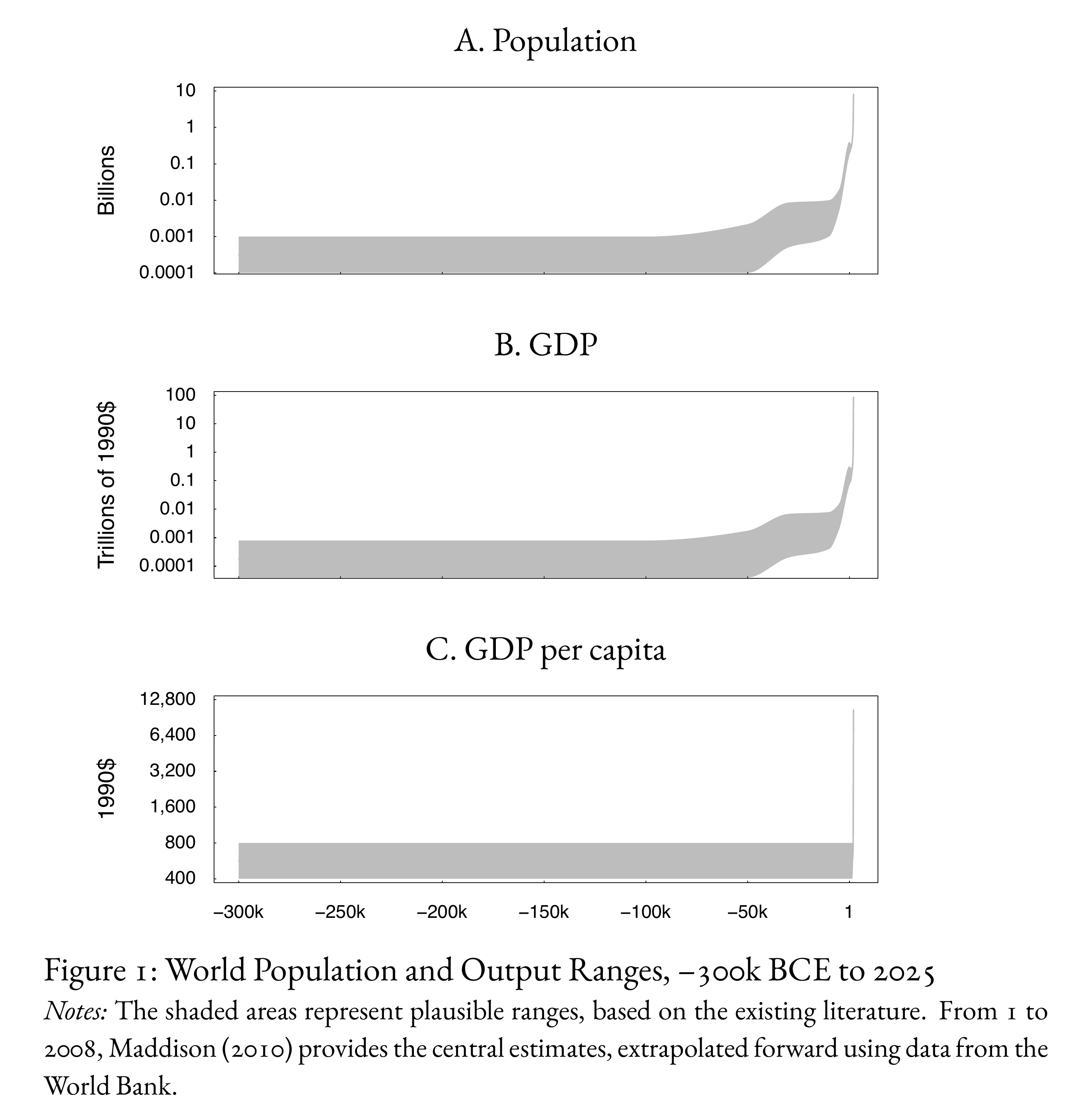
It is unlikely that growth was constrained in this period due to a lack of ideas. Previously, it was believed that humans had not achieved “behavioral modernity” until the Upper Paleolithic, around 48,000 BCE. Today, however, evidence suggests that the human capacity for innovation is essentially constant. In fact, the severe climate volatility of the Pleistocene likely forced hunter-gatherers to engineer tools to survive but without persistent growth. The mental capacity was there. Hence, art and tools dated to around 100,000 BCE have been found at the Blombos Cave in South Africa. But low population density meant that the networks required for such knowledge to spread did not exist between small, isolated bands. And when sudden ecological shifts proved fatal, the knowledge they had acquired died with them.
It was not until the era known as Marine Isotope Stage 3 that the pressures eased. From around 58,000 to 25,000 BCE, the great expansion of Homo sapiens out of Africa could succeed thanks to climate change. Lower sea levels exposed land bridges, and the highly productive Mammoth Steppe became a productive hunting ground for humans. Greater population density then brought previously isolated groups into contact and allowed them to recombine ideas. Population grew and knowledge accumulated during a period of relative stability that ended with the onset of the Last Glacial Maximum and the violent climate whiplash of the Younger Dryas.
A true population explosion then began once the environmental turbulence ended. The transition into the Holocene epoch brought an era of unprecedented global climate stability after 10,000 BCE. Civilizations were born across the world during a geological anomaly in which average global temperatures varied by no more than roughly one degree Celsius over ten millennia. Compared to the wild swings of the Pleistocene, the Holocene provided a stable environment for populations to grow. As agriculture was established, surpluses grew. Permanent settlements became human megamachines: cities that became capitals of states. At their pinnacles were the warrior classes and their brahmins, the specialized producers of knowledge. They were sustained by the surpluses extracted from the peasantries through taxation.
This was the structural prerequisite for Jones’s view of long-run economic history. Jones implicitly takes the unique ecological stability of the Holocene for granted, then concludes that population growth made the industrial revolution inevitable. Yet population growth and the network-based knowledge production system it made possible were contingent on the Holocene. Without it, the explosive growth that Jones theorizes would not have happened.
And then came the Anthropocene.
Knowledge production drove it. As distinct nodes of civilization were established across the globe, their peoples both competed and cooperated, becoming enmeshed in vast, interconnected networks through which ideas travelled. This exchange accelerated technological progress, culminating in the industrial revolution, powered by the mass extraction and burning of fossil fuels. Carbon emissions in turn altered the Earth’s atmosphere, ushering in the Anthropocene—the geological age in which humans’ activities drive environmental change. We have, for example, delayed the onset of the next ice age, breaking the cycle of glaciation that characterized the Pleistocene. Our own ingenuity has inadvertently allowed us to override the natural orbital forcings that have governed the planet’s climate for millions of years.
Yet the Anthropocene could prove to be misanthropic. The implications for the growth of our species could be severe. We are, for example, disrupting the Atlantic Meridional Overturning Circulation (AMOC), a massive system of ocean currents that regulates climate across the northern hemisphere. Greenhouse forcing is expected to significantly weaken the AMOC, and some statistical early-warning indicators suggest it may be approaching a tipping point toward total collapse–possibly this century. The result would be a dramatic cooling of the North Atlantic region, leading to much harsher winters, crop failures, and significant disruptions to marine ecosystems. Beyond the North Atlantic, it would shift the tropical rain belt southward, severely weakening the African and Asian monsoons that billions rely on for agriculture.
New ideas will be required to adapt to such a world. New crops will need to be engineered and coastal defenses built. Energy and food systems will have to be reordered. Perpetual resource wars will need to be avoided. Innovation would be required simultaneously in multiple fields to maintain standards of living.
The problem, as Jones has spent much of his career pointing out, is that new ideas seem to be becoming harder to find. His major contribution to economics came in 1995, when he observed there was a problem with Paul M. Romer’s endogenous growth model. In “Endogenous Technological Change” (1990), Romer posited that the long-run growth rate of the economy is driven by the number of researchers producing new ideas. As a result, more investment in education was required to raise the level of “human capital” to promote growth. But in “R & D-Based Models of Economic Growth” (1995), Jones observed that the number of scientists and engineers had increased, while the growth rate of Total Factor Productivity (TFP), the standard measure of technological progress, had remained flat or even declined, as shown in Figure 2. If Romer’s theory were correct, by contrast, the economy should have been growing exponentially, not stagnating.
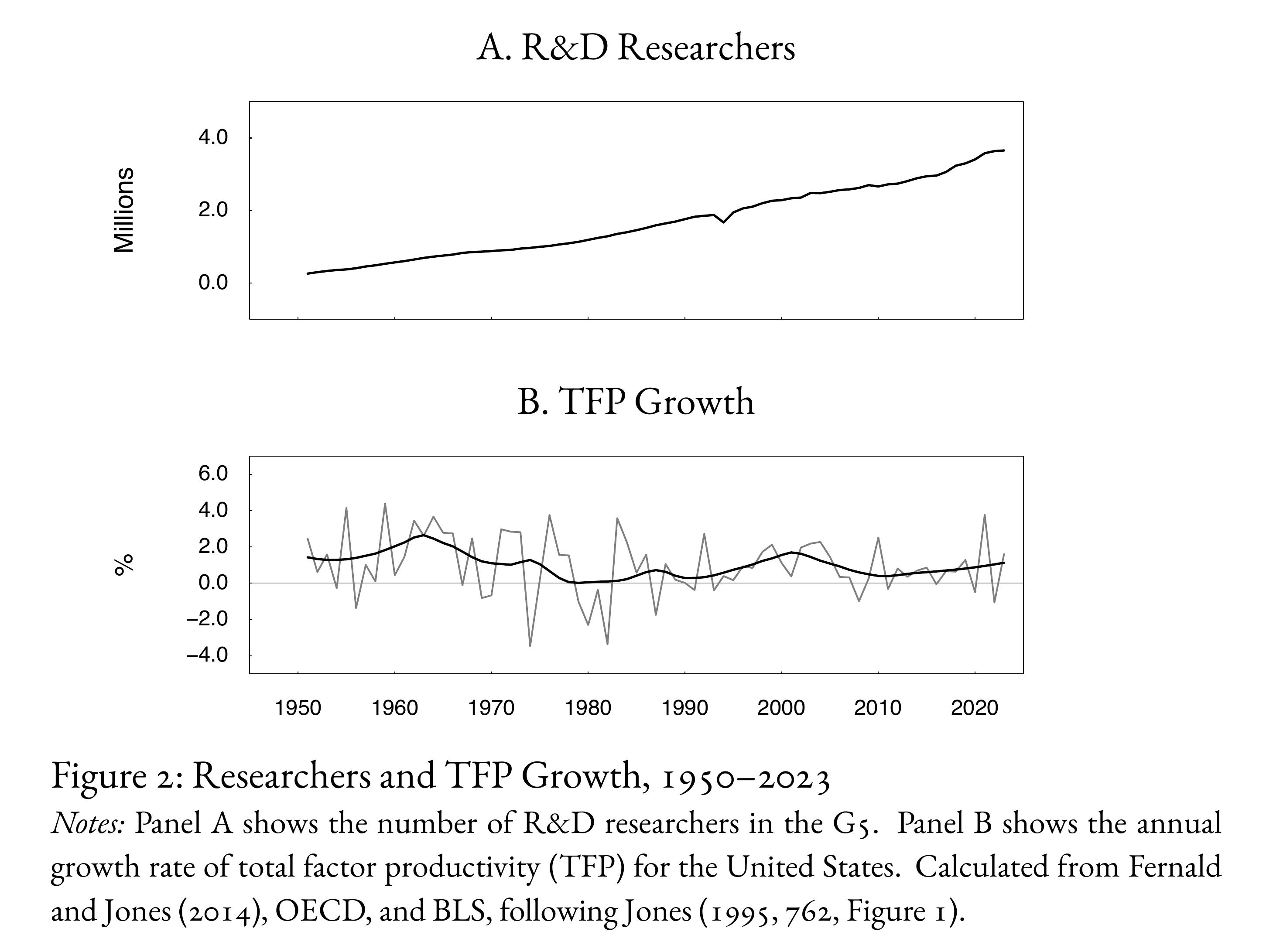
This empirical observation would then become central to Jones’s research over the following thirty years. The parameter defining the relationship between research effort and economic growth (γ) became a recurring theme. In 1995, Jones had stated that the parameters driving gamma were “difficult to separately identify,” prescribing detailed industry-level work as an “important next step” to pin them down. In 2002, he nevertheless gave a formula to derive it: γ = λ / (1 − φ), where λ captures the elasticity of new idea production with respect to the number of researchers (the “stepping on toes” effect) and φ captures the elasticity of new idea production with respect to the existing stock of ideas (the “standing on shoulders” or “fishing out” effect). Yet his empirical estimates implied a λ of 4.535, which he characterized as “implausibly large.” Jones instead imposed values for λ of 1.00, 0.50, and 0.25, from which γ of 0.178, 0.123, and 0.076 mathematically followed.1 In a 2010 paper with Romer, they suggested the parameter could be around 0.25, but added that “one could make a case for a value of γ as high as 1 or even 2.” In a 2014 paper with John Fernald, gamma was defined as 0.38 to close a growth-accounting identity, which led them to conclude that rising R&D intensity had been responsible for 58.1 percent of growth in the United States from 1950 to 2007. In a 2020 paper with Nicholas Bloom, John Van Reenen, and Michael Webb, the focus was “on the benchmark case of λ = 1,” from which gamma was inferred as 0.32. Finally, in 2022, Jones set γ at 0.33 and noted that it “has not been estimated precisely in the literature.”
The possibility that researchers might simply be becoming worse at finding ideas is never mentioned. Crucially, the knowledge production system itself does not enter into his model. “This black box of where ideas come from is a big mystery,” he notes in a recent lecture. But he claims it does not matter due to a model in which notionally empirical parameters can be set to make it fit reality. “It turns out from the growth perspective you don’t have to solve that mystery,” Jones explains. The dysfunctional reality of the knowledge production system is subsumed into a single exponent that is treated as if it were an immutable law of physics.
The evolution of human culture nevertheless suggests why the knowledge production system might be in trouble. The unprecedented growth in living standards since the eighteenth century was made possible thanks to a historically contingent network structure. Yet evolution suggests that there is a limit to the benefits of such connectivity. When panmixia occurs in evolutionary biology, spatial isolation breaks down and a population mates entirely at random across a single pool. Without isolated sub-populations, unique local adaptations are lost to global homogenization. Applied to knowledge, a similar trap occurs when researchers merge into a single, homogenized network. The exchange of distinct perspectives that facilitated innovation in the past ceases due to groupthink.
Jones’ own profession illustrates how the panmictic trap can be set. In the nineteenth and early-to-mid twentieth centuries, the discipline was characterized by distinct, partially isolated schools of thought, often separated by national borders and oceans. Its heyday came in the 1950s, with the fierce debate about the nature of capital between the professors of Cambridge, Massachusetts, and the professors of Cambridge, England. Cheap air travel then made such a controversy impossible to repeat. Economists from across the world began to attend the same conferences. They all became colleagues. The bureaucratic needs of university administrations and funding agencies gave, moreover, incredible power to the “top five” journals, whose editors must now be placated for an economist to succeed. The profession is now dominated by a single, monolithic network that almost every ambitious researcher must belong to in order to succeed. Few ideas are exchanged.
The risk now is that AI will entrench such processes. Academics who too often resemble flesh-and-bone large language models are now to be aided by machines. OpenAI is rolling out unlimited access to ChatGPT to the staff of the world’s leading universities. In doing so, it could accelerate the production of research that contributes little to knowledge. The slop factor will increase. Prominent economists will, for example, publish and cite articles in which parameters are set to make a model fit the data, even though the result is obviously unrealistic based on its out-of-sample predictions. Groupthink will be further reinforced by sycophantic machines. As a result, we will be ill-equipped to imagine the policies that could make societies more resilient to climate change.
Jones’ hopes for the future could then be dashed. Far from the collapse of the knowledge production system, Jones sees in AI the potential to mitigate the effects of slower population growth. He envisions a “flywheel effect” in which machines augment the efforts of humans to find new ideas. The logic should be familiar:
More output (Y)
↓
More research resources (R)
↓
More ideas (A)
↓
Better AI/automation
↓
More output (Y)
The idea is that AI will provide enough compute to discover the ideas that have become increasingly hard to find. The dysfunction of the knowledge production system means, however, that AI may simply accelerate the production of slop, pushing researchers further into the panmictic trap.
If this happens, it is hard to see how humanity will generate the ideas that we need to prosper in the Anthropocene. Anthropic’s economist may be disappointed.
Notes
In his 2002 article, Jones uses three types of estimates: static levels, an error-correction model, and a nonlinear model. All, however, are effectively trend-ratio estimators that converge to the ratio of two independent drifting series. They also have no additional forecasting content: given that γ is estimated as the ratio of the two mean growth rates, a recursive one-step-ahead forecast yields a Theil’s U of exactly 1.000. The semi-endogenous forecast is simply that growth continues at its average rate. ↩
Further Reading
Jones’s quantitative simulation of the Industrial Revolution:
Jones, Charles I. “Was an Industrial Revolution Inevitable? Economic Growth Over the Very Long Run.” Advances in Macroeconomics 1, no. 2 (2001): Article 1.
Kremer’s million-year population model, which provided the empirical foundation for Jones’s takeoff framework:
Kremer, Michael. “Population Growth and Technological Change: One Million B.C. to 1990.” Quarterly Journal of Economics 108, no. 4 (1993): 681–716.
The semi-endogenous growth model and Jones’ critique:
Romer, Paul M. “Endogenous Technological Change.” Journal of Political Economy 98, no. 5, Part 2 (1990): S71–S102.
Jones, Charles I. “R & D-Based Models of Economic Growth.” Journal of Political Economy 103, no. 4 (1995): 759–784.
Jones’s parameterization of research productivity (γ) and growth accounting:
Jones, Charles I. “Sources of U.S. Economic Growth in a World of Ideas.” American Economic Review 92, no. 1 (2002): 220–239.
Jones, Charles I., and Paul M. Romer. “The New Kaldor Facts: Ideas, Institutions, Population, and Human Capital.” American Economic Journal: Macroeconomics 2, no. 1 (2010): 224–245.
Fernald, John G., and Charles I. Jones. “The Future of US Economic Growth.” American Economic Review 104, no. 5 (2014): 44–49.
Bloom, Nicholas, Charles I. Jones, John Van Reenen, and Michael Webb. “Are Ideas Getting Harder to Find?” American Economic Review 110, no. 4 (2020): 1104–1144.
Jones, Charles I. “The Past and Future of Economic Growth.” Annual Review of Economics 14 (2022): 125–144.
Jones’s recent work on AI, automation, and long-run growth:
Jones, Charles I., and Christopher Tonetti. “Nonrivalry and the Economics of Artificial Intelligence.” NBER Working Paper No. 34779, 2026.
Deep-time climate history, human evolution, and Holocene stability:
Mellars, Paul, Katie Boyle, Ofer Bar-Yosef, and Chris Stringer, eds. Rethinking the Human Revolution: New Behavioural and Biological Perspectives on the Origin and Dispersal of Modern Humans. Cambridge: McDonald Institute for Archaeological Research, 2007.
Steffen, Will, Paul J. Crutzen, and John R. McNeill. “The Anthropocene: Are Humans Now Overwhelming the Great Forces of Nature?” Ambio 36, no. 8 (2007): 614–621.
Fagan, Brian, and Chris Scarre. Ancient Civilizations. 4th ed. London: Routledge, 2016.
Hallett, Emily Y., Michela Leonardi, Jacopo Niccolò Cerasoni, Manuel Will, Robert Beyer, Mario Krapp, Andrew W. Kandel, Andrea Manica, and Eleanor M. L. Scerri. “Major Expansion in the Human Niche Preceded Out of Africa Dispersal.” Nature 644 (2025): 115–121.
The AMOC tipping point and climate impacts:
Ditlevsen, Peter, and Susanne Ditlevsen. “Warning of a Forthcoming Collapse of the Atlantic Meridional Overturning Circulation.” Nature Communications 14, no. 1 (2023): 4254.
The panmictic trap, cultural evolution, and AI’s impact on knowledge networks:
Derex, Maxime, and Robert Boyd. “Partial Connectivity Increases Cultural Accumulation Within Groups.” Proceedings of the National Academy of Sciences 113, no. 11 (2016): 2982–2987.
Messeri, Lisa, and M. J. Crockett. “Artificial Intelligence and Illusions of Understanding in Scientific Research.” Nature 627, no. 8002 (2024): 49–58.
Czaplicka, Agnieszka, Fabian Baumann, and Iyad Rahwan. “Mutual Benefits of Social Learning and Algorithmic Mediation for Cumulative Culture.” Journal of the Royal Society Interface 22, no. 225 (2025): 20240686.

,_carrer_de_Mozart.jpg)