The Poor Rich World

The Poor Rich World

Did Europe Underdevelop Africa?

The Slave Trade Illustrates the Limitations of “Historical Economics”

Joseph Francis's avatar
Joseph Francis
Jun 28, 2026
∙ Paid

In How Europe Underdeveloped Africa (1972), Walter Rodney tells a complex story. He covers 500 years of history, beginning in the fifteenth century and reaching into the late twentieth century. Europe’s rise and Africa’s ruin are seen as parts of a single process of uneven development. It began with the Atlantic slave trade and the export of millions of people in their most productive years and turned local states into raiding machines. Farming was disrupted. And then the nineteenth century brought deindustrialization due to cheap imports of ironware and textiles, following the Industrial Revolution. The result, in Rodney’s terms, was “a gale-force wind, which shipwrecked a few societies, set many others off course, and generally slowed down the rate of advance” (p. 135). Then colonialism stopped progress entirely, according to Rodney. Surplus was extracted, industrialization deliberately blocked, African states dismantled, and “tribalism” encouraged because it allowed the Europeans to divide and rule. This is, then, a complex narrative with multiple causal channels that explain how Europe underdeveloped Africa.

Nathan Nunn’s analysis is, by contrast, far simpler. As Nunn explains in his 2005 PhD dissertation, he seeks to link “Africa’s history of extraction with its current level of development” (p. 112), inspired by Acemoglu, Johnson, and Robinson. His key contribution, published as an article in the Quarterly Journal of Economics in 2008, reports a negative correlation between the extent to which modern African countries had suffered due to the slave trade in the past and their current incomes per capita at the turn of the twenty-first century. The slave trade had, Nunn argued, underdeveloped Africa: everything that happened subsequently was of secondary importance.

By now, the fragility of this finding should be well-known. Ewout Frankema and Marlous van Waijenburg first demonstrated it in 2011, in a working paper for the Center for Global Economic History and the University of Utrecht, although their critique then disappeared from the version of the paper published in the Journal of Economic History. They demonstrated that there was no statistically significant negative correlation between Nunn’s estimates of slave exports per country (normalized to land area) and GDP per capita in either 1950 or 1960, with p < 0.10 only being achieved from 1970 up to 2000. Leticia Arroyo Abad and Noel Maurer then went further by updating the test to 2018. “Significance and coefficient size both rise in the 1960[s],” they note, “but in the 1990s the coefficient begins to shrink and p-values begin to rise. By 2018, the relationship has attenuated significantly” (p. 54). The pattern they observed can be seen replicated below, with the 95 percent confidence interval crossing the zero line from 2013 up to 2022. The magnitude and statistical significance of the effect Nunn found seems to depend on which year is used for GDP per capita.
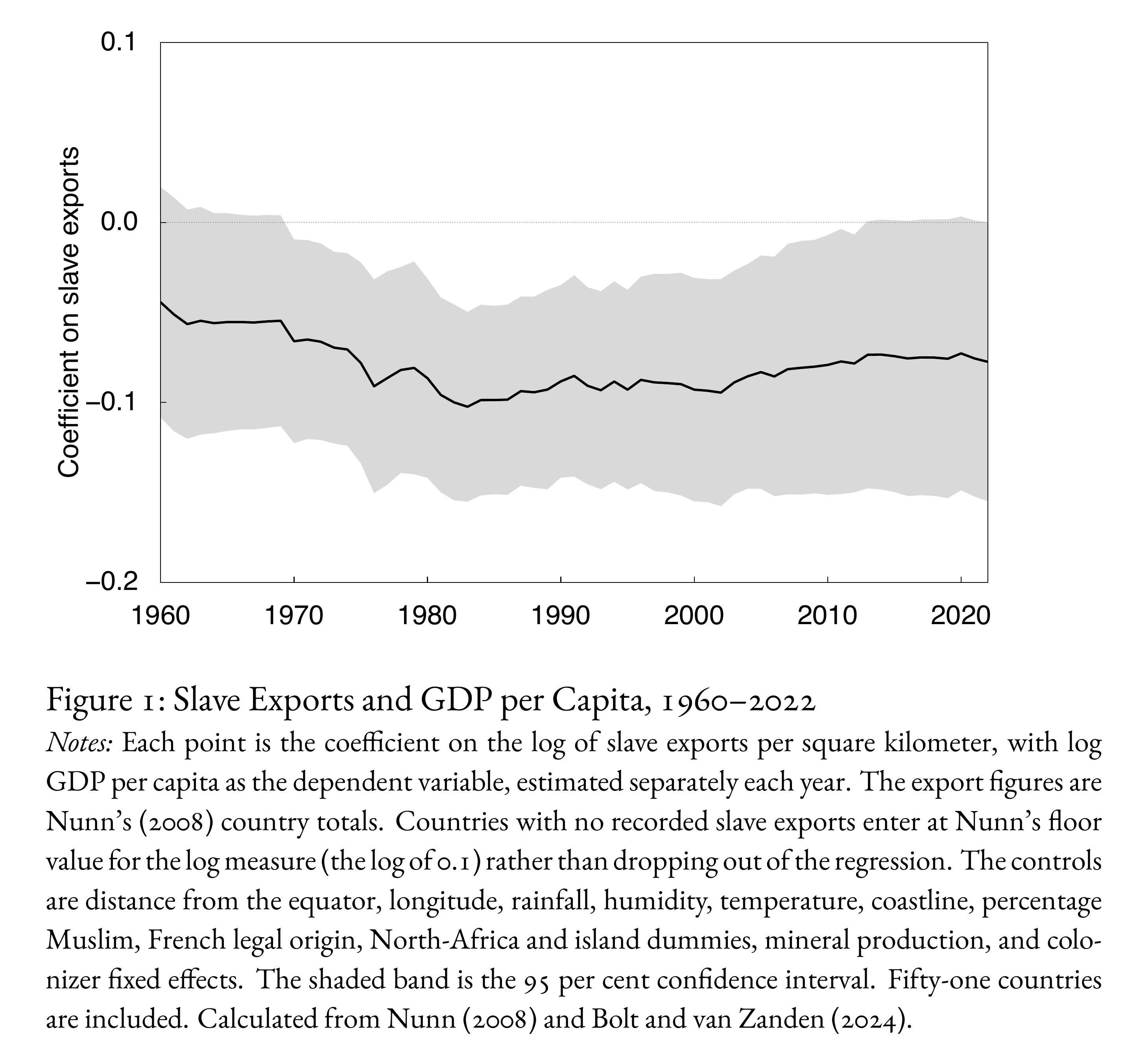
fig1_gdp

Yet the critiques have largely ignored Nunn’s data construction, which is my speciality. According to his 2008 article, his country-level export numbers were produced by “combining data from ship records on the number of slaves shipped from each African port or region with data from a variety of historical documents that report the ethnic identities of slaves that were shipped from Africa” (p. 140). In doing so, he tried to bridge the gap between the data on the ports of embarkation and the places where people were actually captured and enslaved. For the Atlantic trade, Nunn reports using “54 different samples, totalling 80,656 slaves, with 229 distinct ethnic designations reported”; for the Indian Ocean, “six samples, with a total of 21,048 slaves and 80 different ethnicities reported”; for the Red Sea, two samples that “provide information for 67 slaves, with 32 different reported ethnicities”; for the Sahara, another two samples that “provide information on the origins of 5,385 slaves, with 23 different ethnicities recorded.” Using these samples, Nunn describes how he assigned the exports from each port to modern countries based on a variety of secondary sources that reveal where each ethnicity was located.

The problem is that the described methodology is based on a conceptual error. Nunn confuses the labels assigned to the enslaved with their actual ethnicity, even though some of his sources make the difference clear. In The Atlantic Slave Trade: A Census (1969), Philip Curtin makes it clear that what Nunn treats as ethnicities are often shipping points:

For the Gold Coast, ‘Mine,’ the name most commonly found, is another shipping point, the ancient fort at Elmina, but the name had long since been extended to mean any of the Akan peoples. In Portuguese usage of the eighteenth century it was used still more broadly to mean almost anyone from West Africa, but more narrowly those from the Slave Coast on the Bight of Benin. ‘Coromanti’ and its variants were similar and derived from the Dutch fort at Kormantin, less than twenty miles east of Elmina. In English usage it, rather than Mina, was used for Akan peoples generally, but what distinction could have been in the mind of a West Indian lawyer more than five thousand miles away when he wrote ‘Mine’ rather than ‘Coromanti’ against a man’s name? (pp. 185–186)

David Geggus makes the same point:

Even where African equivalents are given, the colonial terms, geographic rather than cultural, do not exactly equate with the ethnic groups they suggest, being probably rather broader. ‘Congo’ meant almost anyone shipped from the coast between Gaboon and North Angola; ‘Senegal,’ perhaps people from the banks of the River Senegal; ‘Mina’ and ‘Caramenty,’ apparently Akan and others shipped from Elmina and Kormantyn. (p. 16, Table 5)

Even when the sources seem to agree with Nunn’s usage, their own data tends to contradict them. Manuel Moreno Fraginals, writing on nineteenth-century Cuba, claims that the slave trade was too large and too commercial to have kept up a meaningless classification:

a business of this size would never have kept up a classificatory scheme had it not been meaningful (in overall general terms, in keeping with reality) in designating in a very precise way the merchandise that was being traded. (p. 190)

In reality, however, Moreno Fraginals’ tables sort Cuba’s slaves into Carabalí, Congo, Mandinga, Lucumí, Gangá, and Mina: the same port and regional labels found elsewhere. They are not ethnicities.

This means that Nunn’s stated methodology cannot sensibly reassign slave exports from the port of embarkation to the places of origin. Port and regional labels from small samples of the enslaved are used to reassign embarkation estimates drawn from the far more abundant shipping records.

To test the sensitivity of the slave trade-GDP per capita correlation to this issue, I have produced my own estimates of the plausible ranges of slave exports by both place of embarkation and origin. To do so, I start from the best-documented figures available: the captives recorded as embarking from each stretch of the African coast, in the SlaveVoyages database, compiled by David Eltis and his co-authors. Even these are not simple counts, and they have been subject to some criticism. Most notably, Paul E. Lovejoy has warned that these estimates should not be reified, given that they rely on “a series of imputed variables” (p. 2). But those imputations are, at least, well documented, making it possible to see where the margins of error are likely to lie. Hence, about 649,000 captives are entered simply as leaving the “Costa da Mina”; I therefore divide them between Benin, Nigeria, and Togo, but with a range of possible distributions between the three countries, rather than giving a false impression of certainty. Reliably assigning those exports to places of origin then becomes harder still. I do so using various sources. For the nineteenth century, SlaveVoyages provides a register of the names of liberated Africans, which can be used to roughly assign some of the Atlantic trade for that period. Prior to that, I rely on the regional historiography. Throughout, I use ranges of plausible distributions that are widest where the evidence is thinnest. The results can be seen below, while the full data construction is described in the appendix to this post, where I also detail various other corrections to Nunn’s dataset, such as how he gives Ethiopia a 113,090-kilometer coastline, almost three times the circumference of the Earth.

t2_exports

The results surprised me.

It turns out that the more realistic series produces a negative correlation that is more robust to the Frankema-van Waijenburg-Arroyo Abad-Maurer critique: the coefficient remains statistically significant throughout. The correlation is, moreover, robust to an array of tests. The correlation found by Nunn seemed so fragile due to the flaws in his own data construction.1

fig1_gdp_origins_percap

Nonetheless, the maps below indicate that this result should not be taken as confirmation that the slave trade explains Africa’s underdevelopment today. I will explain why.

map1_independent
User's avatar

Continue reading this post for free, courtesy of Joseph Francis.

Or purchase a paid subscription.
© 2026 Joseph Francis · Privacy ∙ Terms ∙ Collection notice
Start your SubstackGet the app
Substack is the home for great culture