
Milei and the Maddison Project
New estimates of Argentina’s relative GDP per capita lead to a better understanding of the country’s decline

Today’s blog post is in the form of a video:
In it, I describe my new estimates of Argentina’s GDP per capita relative to the United States. It is the first major fruit of my research since I began the project a couple of weeks ago:
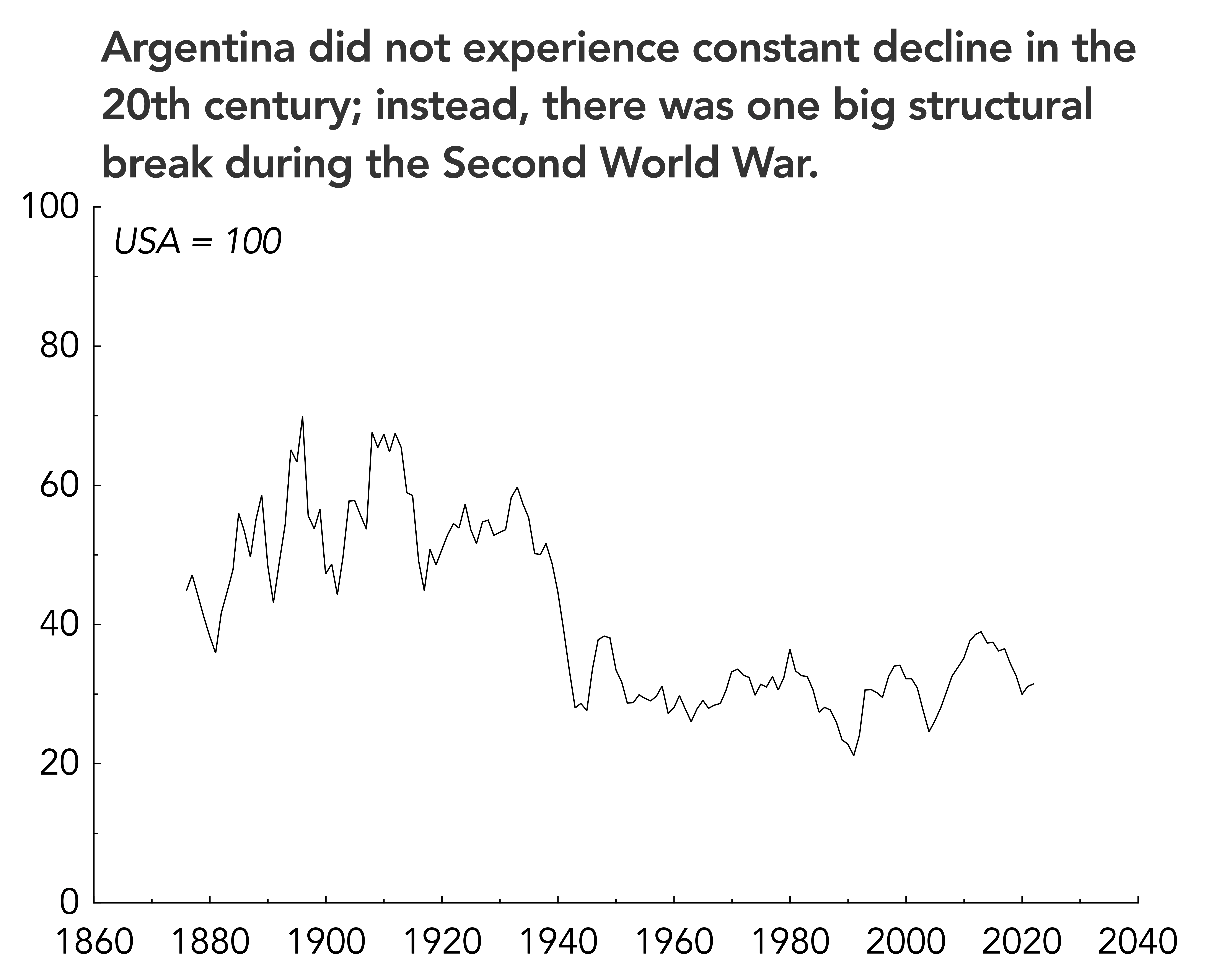
In the video, I say plenty about the significance of this finding. Here, I’d just like to make a few further notes:
These are preliminary estimates and I will continue working on them, depending on funding (please donate!).
In case I seem a little unfair on the Maddison Project, their working papers do describe the problems with the database, even if they downplay them somewhat. The issue is that most users of the data ignore the working papers.
The price levels have been calculated using benchmarks for 1908, 1960, 1980, 2005, and 2017. The first benchmark is my own calculation, while the others are those of international organizations, especially the World Bank.
To interpolate between and extrapolate from those benchmarks for 1876 to 1946, I have used the new consumer price indices of Martín Cuesta and Cecilia Lanata-Briones. I also use them to convert constant-price estimates of GDP to current prices prior to 1935.
I haven’t been able to reconcile my results for 1950 to 2017 with those of the Penn World Table (PWT). The problem seems to come from the United Nations’ National Accounts Main Aggregates Database (NAMAD), which the PWT uses. Argentina’s GDP statistics and exchange rates in the NAMAD are unlike anywhere else, and I’m not sure why. If anyone has any ideas, please let me know.
Again, depending on funding (please donate!), my book will have a long online statistical appendix in which I go into a lot of details about the construction of the estimates.
I am an independent scholar, so my opportunities for funding are limited. Any donation you can make to help me write The Poor Rich Nation would be fantastic.
Interesting video. I see no reason not to accept your data on Argentina, but I differ in interpretation.
I think Argentina during the golden age was basically a form of a petrostate without petroleum. By which I mean it had a very low population situated in a vast expanse of agricultural land. This basically gave the same effects as a small petrostate, hence the terms of trade boom during the golden years.
What happened during WWII? Part of it was a breakdown in trade, but frankly most of that happened after WWI. I think a bigger issue was mechanisation of agriculture. Argentina had a very backwards economy but it didn't matter because terms of trade were so good prior to mechanisation. But mechanisation caused food prices to fall and did so in a structural way. This began in the 1930s but accelerated in the 1940s and 1950s.
So the single issue that kept Argentina artificially rich was no longer present, and thus their economy fell back to earth, so to speak. I think your argument about an "expectation crisis" playing havoc is probably true, but that was not the underlying cause, but rather an inadvertent side effect.
Finally, Argentina's inability to catch up should perhaps not surprise us given that their previous era was built on thin foundations. They had little to no innovation prior to WWII and very little industrialisation and thus were unable to change that after WWII.
I think it was easier for the likes of South Korea or Japan who had no real natural resources to lean on (whether petroleum or agriculture) and were forced to get rich the Western way: industrialisation and technological change.
I think a modern parallell to Argentina's experience should probably be Saudi Arabia. They are too big to transition to a new growth model without industrialisation, such as becoming a hub for gambling, tourism or tax evasion (e.g. Dubai). While their petroleum sector is modern, they have no prior experience of industrialisation. If fossil fuels stop being a money maker then they will face the same problems Argentina did after food prices entered a structural decline.