
The Rise of Europe, Recoded
Data Construction Is Again an Issue in Acemoglu, Johnson, and Robinson

In Why Nations Fail (2012), Daron Acemoglu and James Robinson tell a story about the rise of England. They argue that the country was primed to benefit from the expansion of Atlantic trade because it had better institutions to begin with. The discovery of the Americas enriched a commercial class that forced further constraints on the monarch, improving the country’s institutions, which then promoted growth. In more absolutist countries, by contrast, Atlantic trade reinforced the position of the crown, reinforcing absolutism. Atlantic trade thus benefitted England because of its good institutions, whereas it only reinforced bad institutions in Spain and France.
To support their case, Acemoglu and Robinson cite an article co-authored with Simon Johnson and published in the American Economic Review in 2005: “The Rise of Europe: Atlantic Trade, Institutional Change, and Economic Growth.” In that article, the triumvirate known as “AJR” use XCONST—a 1 to 7 score for the degree of the constraint on the executive of a country, based on the measure developed by the Center for Systemic Peace as part of their Polity Project—to make their case. At a score of 1, this measure indicates unlimited authority, with no regular limitations on the executive’s actions; at 7, the legislature holds effective authority equal to or greater than the executive. AJR code this variable for 26 countries. With log GDP per capita as the dependent variable for the years 1500–1820, AJR show that a triple interaction term of XCONST in 1400 and 1500, the volume of Atlantic trade, and a dummy variable for whether a country was an Atlantic trader or not produced a coefficient of 0.14, statistically significant at p < 0.001. In other words, among the countries that traded across the Atlantic, those that began with stronger checks on their rulers pulled further ahead in income as that trade expanded, while in countries where the ruler was unconstrained the same trade did little.
According to AJR, the construction of their key variable is straightforward. “While there may be disagreement about the precise values used in particular years,” AJR write, referring to XCONST, “the general level of constraint on the executive does not appear to be controversial.” And they give various examples: “the absolutist regimes of France, Portugal, and Spain clearly had much less constraint on the executive than did the Netherlands after independence or England after the Civil War.”
António Henriques and Nuno Palma nevertheless challenged this claim. In an article published in the Journal of Economic Growth in 2023, they argued that AJR had not done “a detailed comparative analysis of sources” when coding XCONST. Rather, “the only source used is a reference work of a summary encyclopedic nature for ‘world history.’” Specifically, AJR relied on the fifth edition of William L. Langer’s Encyclopedia of World History, published in 1972, supplemented by the revised sixth edition by Peter N. Stearns, published in 2001. It was, as Henriques and Palma observed, a remarkably thin evidentiary base to code almost 900 years of institutional history across 26 countries, but AJR did.
Portugal and Spain featured prominently in Henriques and Palma’s critique. For both countries, AJR had coded XCONST as 2 in 1400 and 1 in 1500, the two key years in their analysis of how initially high levels of constraint on the executive had interacted with Atlantic trade to generate growth. Henriques and Palma, however, marshalled an array of evidence—how frequently the Cortes and the English Parliament actually met, their power to grant or refuse taxation, the real interest rates the two crowns paid on their public debt—that suggested that the monarchs of these countries faced similar constraints as the King of England.
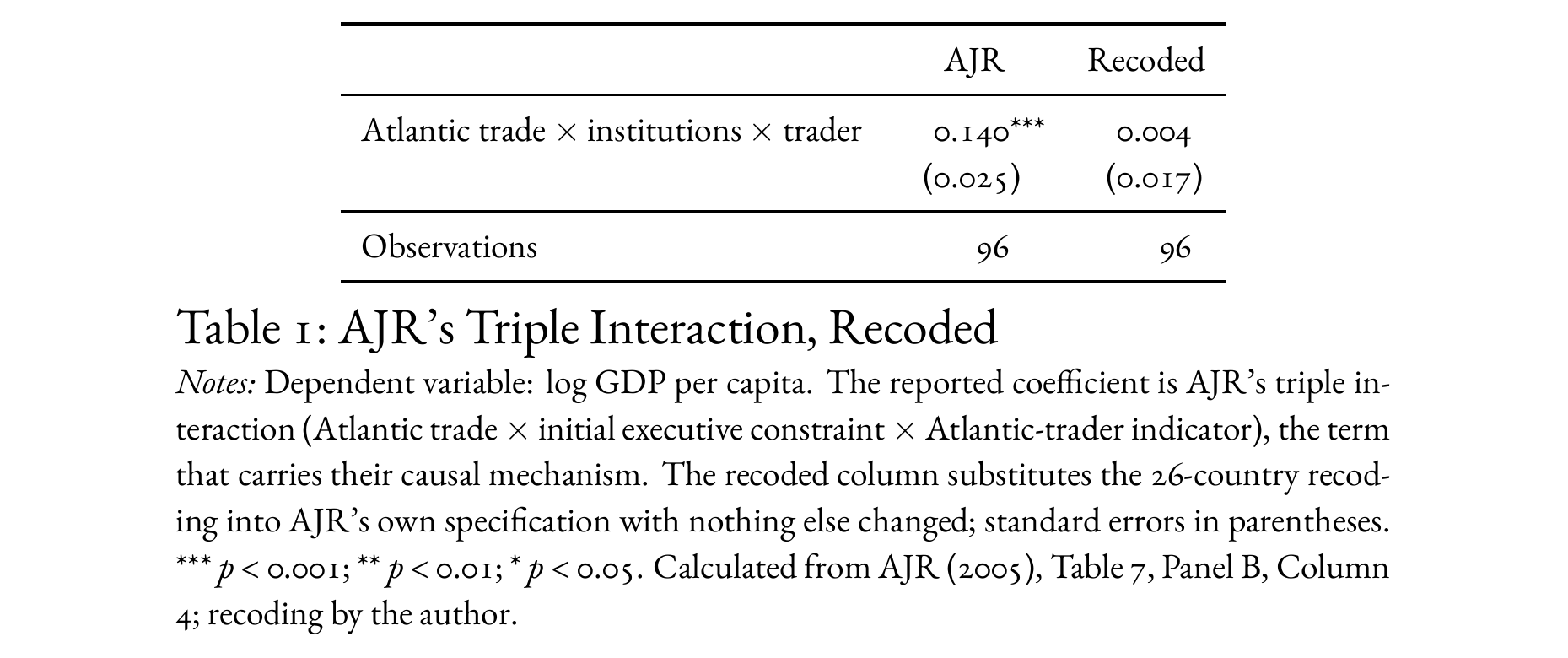
Correcting the coding then killed AJR’s key result. The coefficient of the triple interaction term falls from 0.14 to 0.004 in Henriques and Palma’s replication of the same regression, while p rises from <0.001 to 0.64. The original result thus appears to have been an artifact of using inadequate sources to code institutions. Much of the narrative underlying Acemoglu and Robinson’s book Why Nations Fail had little empirical basis.
So I decided to dig deeper. I recoded all 26 countries in AJR’s dataset to see how accurate their version of XCONST was. The results can be seen below, where AJR’s series for 40-year periods are on the left and my annual series are on the right. The appendix to this post describes the sources and reasoning for the recoding for each country in each year.
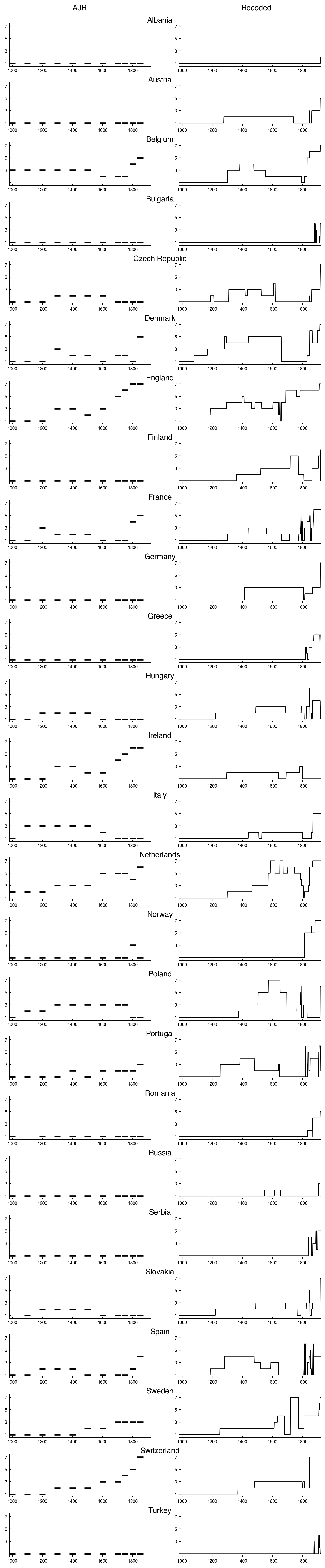
Spain illustrates why the recoding is necessary. In the crucial years of 1400 and 1500, AJR code the country as 2 and 1, respectively. The basis for this coding can be found in Langer, who, on Ferdinand and Isabella, records the “restoration of the royal power in Castile,” under which “the great feudal magnates were deprived of many of their possessions and rights and a royal administration was gradually established,” with the Inquisition “wholly under royal control.” Nonetheless, UNESCO recognizes the Cortes of León of 1188 as the world’s first parliamentary system. In Medieval Parliaments: A Comparative Study (1968), Antonio Marongiu describes it as “the first clear signs of the evolution of the old concilios into true parliamentary institutions.” In The Cortes of Castile-León, 1188–1350 (1989), Joseph O’Callaghan writes that the Cortes was the king’s own court, but “once in session ... often displayed a mind of its own.” And in Parliaments and Estates in Europe to 1789 (1975), A. R. Myers notes that “by the fourteenth century ... the king could not levy extraordinary taxes without an explicit grant from the Cortes.” In my recoding, Spain’s XCONST is therefore increased to 4 in 1400 and 3 in 1500. The score falls because, under Ferdinand and Isabella, the crown began to capture the machinery of representation itself. At the Cortes of Toledo in 1480, as Steven C. Hause and William S. Maltby record in Western Civilization: A History of European Society (1999), “the royal towns of Castile agreed to the appointment of corregidores, royal officials who would reside in the city, protect the interests of the crown, and supervise elections,” which “ensured a high degree of royal authority over city governments and over those who were elected to represent them in the Cortes.” The assembly’s formal powers survived on paper, but the crown now decided who sat in it. As a result, Spain is coded at 3, below England at 4, in 1500.1
The results confirm Henriques and Palma’s critique. As in Henriques and Palma, my full recoding kills the key triple interaction. The coefficient again falls from 0.14 to 0.004, and from p < 0.001 to p = 0.80. The result that is supposed to support the story told in Why Nations Fail is dead.
But we can go further than that.
