
This Ethnicity Is a River
More on the Historical Economics of the African Slave Trade

In his first study of the subject, Nathan Nunn told a simple story in which the slave trade caused Africa’s underdevelopment. Subsequently, he added a mechanism. In an article co-authored with Leonard Wantchekon and published in the American Economic Review in 2011, Nunn argued that ethnic groups that had been victims of the slave trade became more mistrustful due to the “deterioration of preexisting states, institutions, and legal structures.” The result was a story of persistence: “If these institutional effects persist, then people today may have lower levels of trust because poor institutions permit poor behavior, which engenders mistrust” (p. 3245). And Nunn and Wantchekon claimed to have demonstrated this was the case by comparing ethnicity-level estimates of slave exports with the current levels of trust expressed by different ethnicities in Round 3 of the Afrobarometer survey, conducted in 2005–2006.
Yet how the ethnicity-level slave exports were calculated is never made clear. Nunn and Wantchekon claim to have combined “data on the total number of slaves shipped from all ports and regions of Africa with data on the slaves’ ethnic identities.” They pointed toward Nunn’s 2008 article in the Quarterly Journal of Economics for “[f]ull details of the underlying data, their sources, and the construction procedure” (p. 3229). But those details cannot be found. In 2008, Nunn wrote, for example, that “where an ethnicity is located in more than one country, I map the ethnicity into the multiple countries using land area as weights. This is explained in detail in Nunn (2007),” which is the online data appendix to his article (p. 150). In that online appendix, however, the only “detail” given on this procedure is this statement: “I use the fraction of an ethnicity’s land area in each country as weights when assigning the number of slaves from an ethnicity to the relevant countries” (p. 5). The promised details simply do not exist.
What information is given suggests that the methodology is not actually possible. The sources that Nunn cites simply do not contain the relevant data on ethnicities. Rather, they provide the labels that slave traders and slaveholders used to describe their captives. As a general rule, they refer to the broad coastal regions from which people were shipped, rather than a precise guide to ethnicity.
The Kongo provide a prime example. As Pathé Diagne, a Senegalese academic, explained in a paper presented to a meeting on African ethnonyms and toponyms organized by Unesco in Paris in July 1978, it is impossible to determine exactly what is meant when the label is used: “The River Kongo, the language Kongo (Kikongo) and Kongo as used for an ethnic group, as well as for an individual belonging to the group, raises not only a problem of spelling (Kongo or Congo), but also of identification and meaning” (p. 14). This ethnic group is a river, making it impossible to determine whether enslaved Africans labelled “Kongo” by their captors were actually part of the Kongo ethnic group or had merely been shipped from the ports on the stretch of coast where the Kongo River meets the Atlantic Ocean.
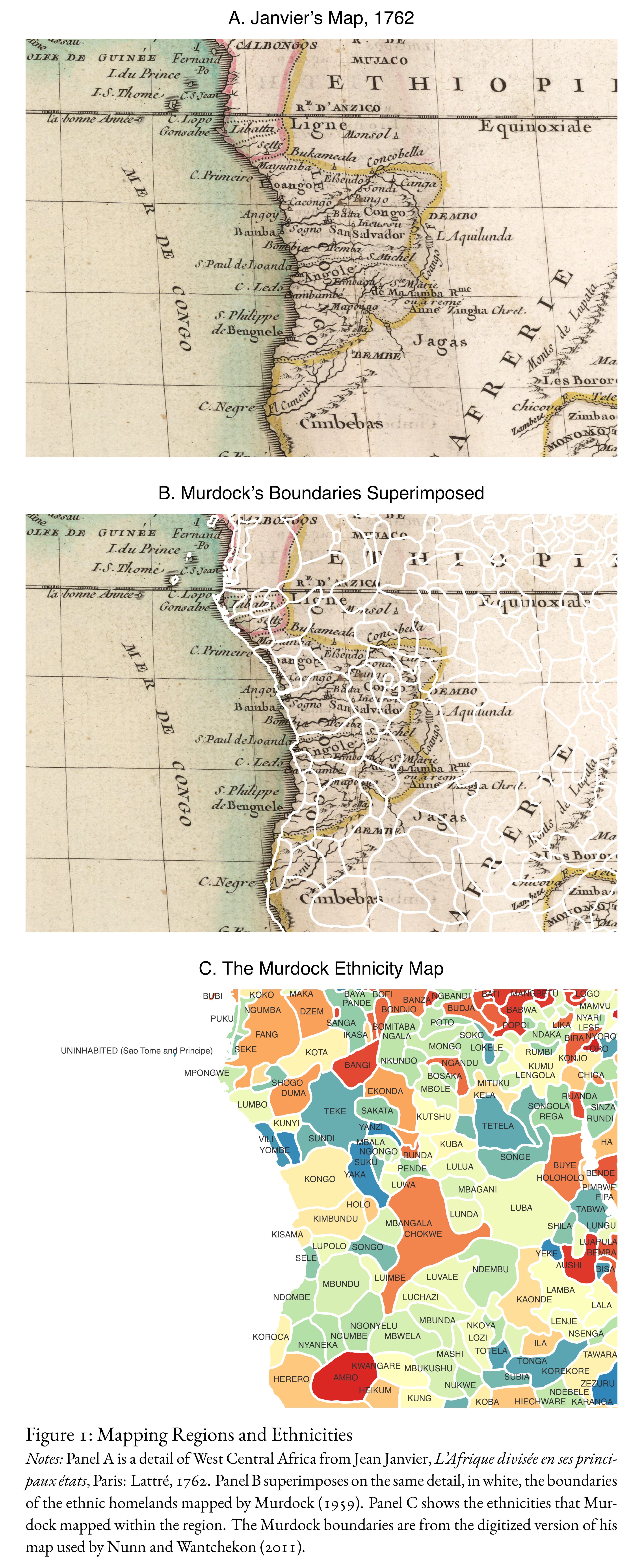
Early European maps of Africa illustrate the problem. Panel A of Figure 1 is, for example, a detail from Jean Denis Janvier’s map of Africa from 1762. The French cartographer used “Congo” to simultaneously refer to the coast, a large region of West Central Africa, and a particular place within it. Panel B shows what Murdock’s mid-twentieth-century ethnicity map used by Nunn looks like when roughly superimposed on top of it. In Panel C, there are then numerous ethnicities mapped within the region that the eighteenth-century mapmaker referred to as the Congo. Nunn nevertheless seems to assign the vast majority of slave exports from West Central Africa to the Kongo polygon. The Kongo receive 87 percent of slave exports from the region because Nunn treats a broad regional label as if it referred to a specific ethnicity.
The result is hard to square with the historical literature. In Way of Death: Merchant Capitalism and the Angolan Slave Trade, 1730–1830 (1988), Joseph Miller argues that the Kongo were intermediaries in the slave trade who were generally not a source of captives themselves. Their lords on the coast “faced squarely west, toward the sea, and grew eminent as brokers between the ship-borne Europeans and their eastern woodland Kongo neighbors” (p. 35). According to Miller, their captives came from far inland: “the broad band of woodland and gallery forest running from the middle and lower Kwango east across the lower courses of the Kasai affluents and north of Lunda was the single major source of the slaves delivered to the Angolan coast during the eighteenth century” (p. 209). Linda M. Heywood then adds nuance in a 2009 article in which she describes how the Kongo state eventually turned on its own people. Once it stopped expanding and waging war against its neighbors, elites began to manipulate the laws that regulated who could be enslaved. Subjects of the Kingdom of Congo became victims, especially during the civil wars that began in the last quarter of the seventeenth century and continued to the eighteenth. Yet even Heywood’s account does not validate Nunn’s assignment of such a high share of exports to the Kongo, given that it was a multi-ethnic state. Indeed, among the 1,018 liberated captives embarked from West Central Africa in 1819–1845 whose names could be assigned to a linguistic group in the African Origins database, only 29 percent were classified as Kongo. And the Kongo linguistic group used by the database was itself broader than Murdock’s Kongo ethnic group, while the single largest linguistic group among these name-classified recaptives was the Luba, from deep in the Kasai interior.
Why this matters can then be seen in an article Nunn co-authored with Sara Lowes. Published in the Royal Society’s Philosophical Transactions in 2024, it claims to show an ethnicity-level correlation between the slave trade and gender relations, specifically whether an ethnicity is matrilineal or patrilineal. In their headline linear-level specification, they found that ethnicities more exposed to the slave trade were significantly more likely to be matrilineal rather than patrilineal. But this specification was entirely dependent on its most influential observation, the Kongo. When the Kongo ethnic group is excluded from the regression, the headline linear-level result collapses: the coefficient for slave exports falls by roughly three-quarters, from 0.0016 to 0.0004, while p rises to roughly 0.8. The headline result is likely to be an artifact of Nunn’s data construction.
Similar issues affect Nunn and Wantchekon’s 2011 article on trust, which is supposed to provide the mechanism that links the slave trade to contemporary underdevelopment in Africa.
